
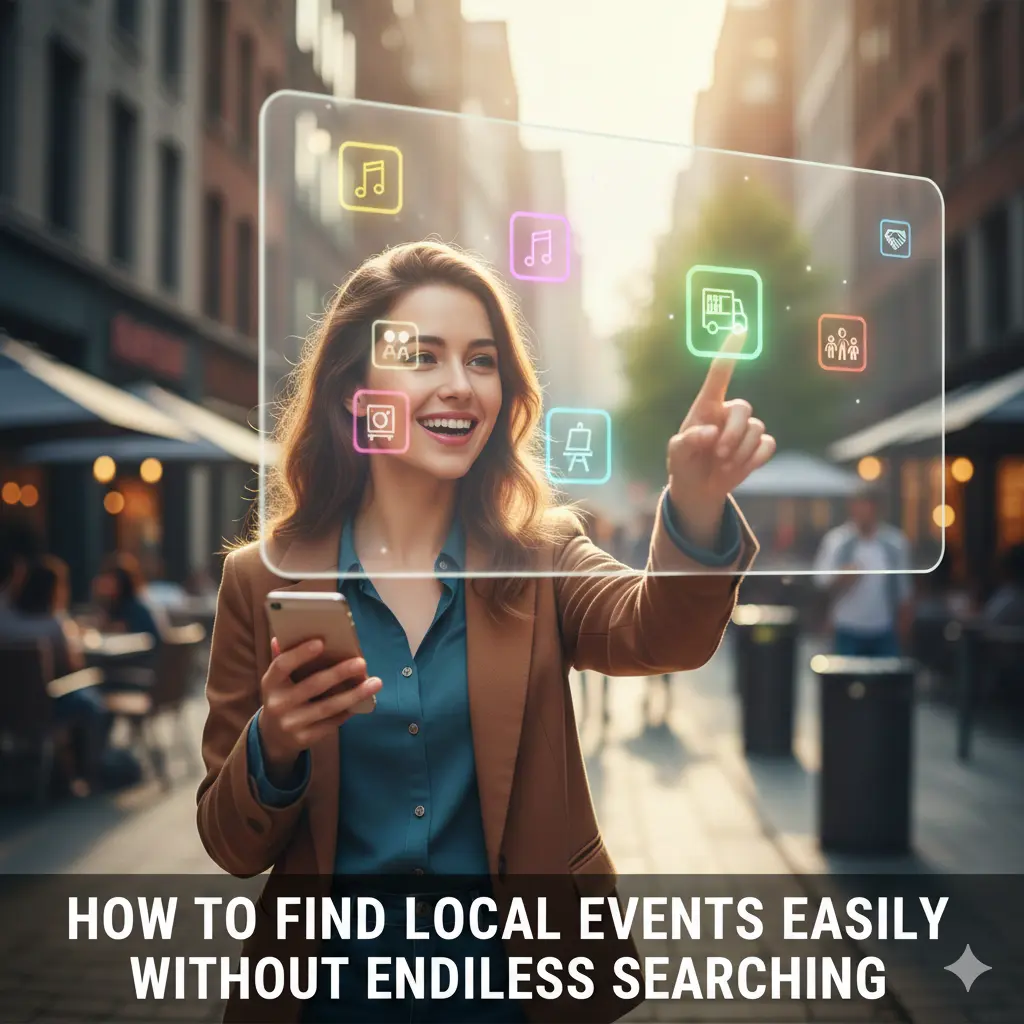
Introduction
Find Local Events Easily — it isn’t about discovering more platforms; it’s about reducing noise and building a simple system that surfaces relevant events naturally. Locals don’t search endlessly for things to do; events usually come to them through routines, places, and people they already trust.
As event listings multiply across apps, social media, and websites, many people feel overwhelmed and still miss the events they’d actually enjoy. This guide explains how locals consistently find events without effort, what signals matter more than algorithms, and how you can build your own low-friction way to stay informed without burnout.
Table of Contents
Why Finding Events Feels Harder Than It Should
How Locals Actually Discover Events
Building a Simple Event-Discovery System
Signals That an Event Is Worth Your Time
Common Event-Finding Mistakes (and Fixes)
Information Gain: Why Algorithms Miss Good Events
Real-World Scenario: Events Finding You
Comparison Table: Searching vs System-Based Discovery
FAQs
Conclusion
Why Finding Events Feels Harder Than It Should
The problem isn’t lack of events—it’s excess information.
Most people rely on:
Multiple apps
Random social posts
Last-minute searches
This creates decision fatigue and inconsistency. Locals avoid this by narrowing inputs instead of expanding them.
H3: Too Many Sources, Not Enough Signals Find Local
More listings don’t equal better recommendations.
H3: Why “What’s On” Pages Overwhelm Find Local
They prioritize volume over relevance.
How Locals Actually Discover Events
Local event discovery is passive, not reactive.
H3: Routine Locations
Cafés, libraries, galleries, and community centers act as information hubs.
H3: Familiar People
Friends, coworkers, and organizers share what aligns with your interests.
[Expert Warning]
If you rely only on algorithms, you’ll mostly see events designed to be promoted—not events designed to be meaningful.
Building a Simple Event-Discovery System
Instead of searching constantly, build a lightweight system.
H3: Choose 2–3 Reliable Sources
One physical place, one online source, one person.
H3: Follow Venues, Not Aggregators
Venues curate events better than platforms.
H3: Check on a Schedule
Weekly or biweekly checks reduce stress.
[Pro-Tip]
Events that appear repeatedly in your life are usually the ones worth attending.
Signals That an Event Is Worth Your Time
Locals evaluate events quickly.
H3: Recurrence
Recurring events signal stability and community interest.
H3: Scale Match
Events that fit the venue size feel better.
H3: Clear Intent
Events with a focused theme usually deliver more value.
[Money-Saving Recommendation]
Many worthwhile local events are free—prioritize those before ticketed ones.
Common Event-Finding Mistakes (and Fixes)
Mistake 1: Searching Only When Bored
Fix: Check consistently, not reactively.
Mistake 2: Chasing Every Recommendation
Fix: Choose based on fit, not popularity.
Mistake 3: Ignoring Physical Spaces
Fix: Notice flyers, boards, and conversations.
Information Gain: Why Algorithms Miss Good Events
A key SERP gap: most guides assume better tech solves discovery.
From real-world observation, algorithms favor:
Paid promotion
High engagement content
Broad appeal Find Local
Small, meaningful events often lack these signals. That’s why locals rely on contextual discovery—events embedded in daily life rather than pushed digitally.
Real-World Scenario: Events Finding You
In practical situations, once you attend a few aligned events, discovery becomes effortless. Organizers recognize you, invitations follow, and events start appearing naturally—without searching.
That’s how locals stay informed: by being present, not proactive.
Searching vs System-Based Discovery Find Local
| Aspect | Endless Searching | Simple System |
| Effort | High | Low |
| Stress | High | Minimal |
| Relevance | Inconsistent | High |
| Discovery Style | Reactive | Passive |
| Long-Term Use | Unsustainable | Sustainable |
Contextual YouTube Embeds (Playable)
FAQs
What’s the easiest way to find local events?
Build a small, consistent discovery system.
Do I need event apps?
Not necessarily—venues and people work better.
How often should I check for events?
Once a week is usually enough.
Why do I miss good events?
Because they’re rarely promoted widely.
Can visitors use the same approach?
Yes—by focusing on venues and community spaces.
Alt: Locals discovering events through conversation in [City]
Infographic: Event Discovery System
Showing passive vs active discovery flow
Internal Linking Plan
Anchor: “community events that feel personal” → Community Events Near You
Anchor: “upcoming cultural events you should know about” → Upcoming Cultural Events in [City]
Conclusion
Finding local events easily isn’t about searching harder—it’s about listening better. When you shift from chasing listings to building a simple system rooted in routine and trust, events start appearing naturally. That’s how locals stay connected to culture without effort or overload.
Internal link
Eternal link

![Underground Cultural Events in [City] You Won’t See](https://poisonmagazine.com/wp-content/uploads/2026/01/Underground-Cultural-Events-in-City-You-Wont-See-214x140.webp "Underground Cultural Events in [City] You Won’t See")
![Local Festivals in [City] Worth Attending at Least Once](https://poisonmagazine.com/wp-content/uploads/2026/01/Local-Festivals-in-City-Worth-Attending-at-Least-Once-214x140.webp "Local Festivals in [City] Worth Attending at Least Once")